Ideal Weight Calculator
 Add as preferred on Google
Estimate your ideal weight based on your gender and height, using the novel Peterson equation for ideal body weight. The calculator output also includes the result from the popular Devine IBW formula for reference. IBW calculator using height compared to weight.
Created by  Georgi Georgiev
Last updated: Dec 13, 2024
- How to calculate your ideal weight
- Applications of Ideal Body Weight (IBW)
- Ideal weight formulas
- Comparing the Peterson versus the Devine formula
- History of ideal weight formulas
How to calculate your ideal weight
The ideal weight calculator needs just your height in centimeters or feet and inches, and your gender (male or female). It uses a modern formula proposed by Peterson et al.[2]. It output includes a result from the older and less accurate Devine formula for comparison. The ideal weight is given in kg or lb depending on your input metrics.
We recommend using the ideal weight calculator above as opposed to any kind of ideal weight chart since charts are by their nature inaccurate as they only give weight range values. Using the formula with your exact measurements is bound to be more accurate.
Applications of Ideal Body Weight (IBW)
The intended use of ideal weight formulas was for prescribing medicine dosage, but their application goes beyond that, as they are used as guides on constructing one's diet and nutritional intake (calories per day). Some, incorrectly, use it as a beauty standard, but it is just a convenient quick estimate of body weight for nutritional and body composition assessments. The Peterson formula, given its relation to the Body Mass Index (BMI), can be used to set a goal weight for reducing the risk of various health issues and diseases.
The ideal body weight calculated from our tool can be used to guide efforts to achieve a healthy weight through weight loss and exercise. It should be interpreted by a physician or another healthcare professional, especially if it will be used as part of long-lasting lifestyle and health decisions. Things to take into account in interpretation include other measurements such as your body fat percentage, muscle mass, waist circumference, existing health conditions, and others.
Ideal weight formulas
This calculator uses the Peterson at al. IBW formula that is more accurate for all intents and purposes than the outdated, but still popular Devine formula. We present both for completeness. None of them uses age as a variable, as it was not found to add accuracy to the estimate.
The Peterson formula
Weight (kg) = 2.2 x BMItarget + 3.5 x BMItarget x (Height (m) - 1.5 m)
BMItarget is the target BMI for the calculation. We use a value of 22 in this online tool.
For a target BMI of 20 the formula looks like so: Ideal weight (kg) = 44 + 70 x (Height (m) - 1.5 m), while for the value of 22 we use as default it becomes 48.4 + 77 x (Height (m) - 1.5 m)
The formula for imperial metrics is not used in our calculator, but is given here for reference:
Weight (lb) = (5 x BMItarget) + (BMItarget / 5)) x (Height (in) - 60 in)
Estimation accuracy
The maximum percent error across the 95% height range was found to be 2.4%. The equation is most accurate at the middle of the range. The mean absolute error it was 1.1 lb and 0.4 kg for the imperial and metric versions, respectively, as estimated via empirical data.
The Devine formula
The B. J. Devine formula for men is:
50 + 0.9 * (Height (cm) - 152)
and for women:
45.5 + 0.9 * (Height (cm) - 152)
Comparing the Peterson versus the Devine formula
We thought it would be useful to draw a comparison graph between the two formulas to highlight their differences. We plotted Peterson's formula with three BMI values: 19, 22, and 25, to illustrate the different behavior and also to serve as a more in-depth comparison to the Devine formula.
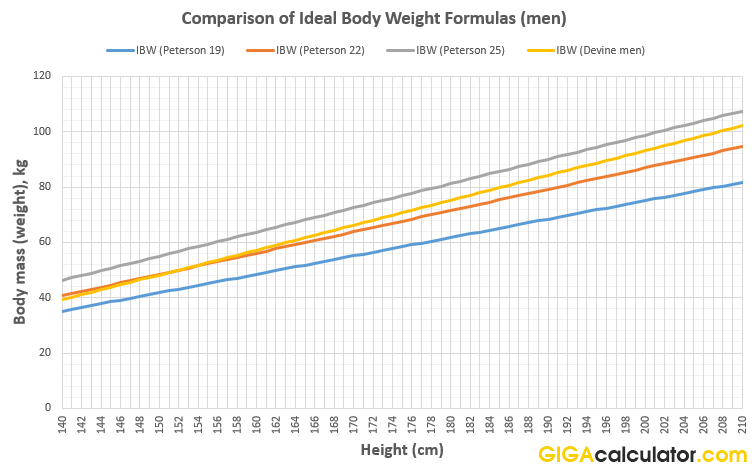
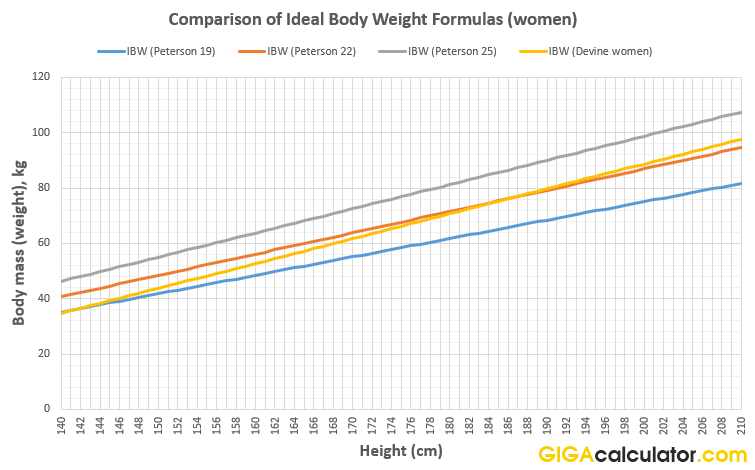
Even without comparison to lean body mass it is evident that Devine's formula suggests too low weight for women in general, but especially shorter ones, as for them the equivalent Body Mass Index becomes quite restrictive. For men it is the opposite - for taller men the calculated ideal weight is a bit on the high end. The charts above were prepared using this ideal body weight calculator.
History of ideal weight formulas
There are multiple formulas for calculating ideal body weight, with the first being invented as early as 1871 by Dr. Pierre Paul Broca, a French surgeon. Much later, in 1974 Dr. B.J. Devine published his famous equation which basically converted a simple rule based on the Broca ideal body weight formula from pounds to kilograms. It is the one used in many IBW calculators, but in our ideal body weight calculator we chose a different approach and we will explain why (we also show the Devine formula result, for reference).
The major issue with the Devine formula is that it is not scientific. Unlike other health formulas, it was not derived from any kind of systematic research, regression analysis, etc. Instead, it was based on estimates from Devine's mentor [1].
Validation of the formula's results versus actual lean body mass and average body mass revealed that the ideal weight estimate is skewed at both ends of the spectrum. It underestimate body weight at shorter heights and overestimate it for persons of higher stature. The problem was not really solved by the attempts at new equations in works of Robinson et al. and Miller et al. in 1983. These issues make IBW equations as a whole incompatible with BMI and combined with the fact that they only prescribe a single value makes them not very suitable, even for their intended purpose. BMI ranges for healthy body weight are often used instead.
Development of the Peterson IBW equation
In attempting to address these shortcomings of the Devine and later formulas, Peterson at al. [2] produced in 2016 a novel body weight equation that is more accurate than past IBW equations and is generalizable to any target BMI and height. Its accuracy was evaluated through both theoretical and empirical means. The empirical validation came from applying it to historical data for adults participating in the 1999-2006 NHANES.
References
Cite this calculator & page
Cite results from this online calculator or information on this page by choosing a citation format:
Georgiev, G.Z. (n.d.). Ideal Weight Calculator. GIGAcalculator.com. Retrieved Sep 27, 2026, from https://www.gigacalculator.com/calculators/ideal-weight-calculator.php