Resting Metabolic Rate Calculator
RMR calculator, a.k.a. resting calorie burn calculator. Easily calculate your Resting Metabolic Rate (RMR) which is how many Calories per day you need if you are just resting. A synonymous term is Resting Energy Expenditure (REE).
 Add as preferred on Google
Created by  Georgi Georgiev
Last updated: Apr 29, 2024
RMR metrics used: 1 Calorie = 1 kcal (1 kilocalorie) = 1,000 calories.
What is RMR?
The Resting Metabolic Rate (RMR) is the amount of energy your body consumes when in a resting state [1]. This calorie burn rate includes your metabolism rate and the thermic effect of food. It is also encountered under the names Resting Energy Expenditure or REE [2][4], as well as RDEE - Resting Daily Energy Expenditure, which is why this tool can be referred to as both an RMR calculator, REE calculator, or RDEE calculator.
Applications of Resting Metabolic Rate
Abbreviations aside, RMR is a huge component of Total Daily Energy Expenditure (TDEE). Usually 60-85% of TDEE and is used to calculate daily caloric needs. This then informs different kinds of diets, food regimes, and nutrient requirements in sports, fitness, and healthcare.
This is also the general application of a Resting Metabolic Rate calculator: calculating metabolism needs, fitness regimen energy requirements, athletes food intake for competitive sports, and so on. Supplement intake and dosage may be governed by the resting metabolic rate as well. Many physical activity trackers, including Android & iOS apps would have an in-built calculator.
RMR versus BMR
RMR is very similar to BMR, but is measured under less strict conditions leading to it having slightly higher values than BMR. The difference is usually so small that in medical literature the two terms can be seen used as synonyms. Under laboratory / clinical conditions resting metabolic rate is measured using the volume of oxygen intake a person has in resting condition. Using our calculator one can estimate a person's RMR with a decent amount of accuracy based on population averages. Read more on RMR vs BMR in the context of weight loss.
RMR formula
The formulae we use in this calculator are different for males and females. All equations take into account age (years), body weight (kg), and height (stature in cm). The resulting RMR / REE values are in Calories.
Mifflin-St Jeor Formula
The first RMR formula commonly used in exercise science [2] is the equation derived in Mifflin, St Jeor et al.[4]. It is based on observations of 251 males and 247 females, including both normal weight and obese individuals. They paper claims that "The Harris-Benedict Equations derived in 1919 overestimated measured REE by 5% (p less than 0.01).". Our RMR calculator automatically calculates both estimates for you.
The equation for men:
RMR (Cal) = 10 x weight + 6.25 x height - 5 x age + 5
The formula for women:
RMR (Cal) = 10 x weight + 6.25 x height - 5 x age - 161
The measurement units are in kilograms and centimeters. If you are wondering what your RMR is and want to manually calculate it, make sure to perform the necessary unit conversions such as (imperial to metric). Then replace the respective values in the equation for your gender. Our tool does all of this automatically, as required.
Harris-Benedict Equation
This equation was derived by Harris & Benedict [3] from observations on 136 men and 103 women. It has mostly been replaced by the more accurate Mifflin & St Jeor formula.
The formula for males is:
RMR (Cal) = 66.4730 + (13.7516 x weight) + (5.0033 x height) - (6.7550 x age)
And for females the equation is:
RMR (Cal) = 655.0955 + (9.5634 x weight) + (1.8496 x height) - (4.6756 x age)
RMR by age and gender
The RMR formula used in our calculator takes age into consideration. The estimates plotted below in Calories per day are for a male and a female with the same body mass and stature (hence BMI), but of different age. The calculations is done using the Mifflin & St Jeor equation.
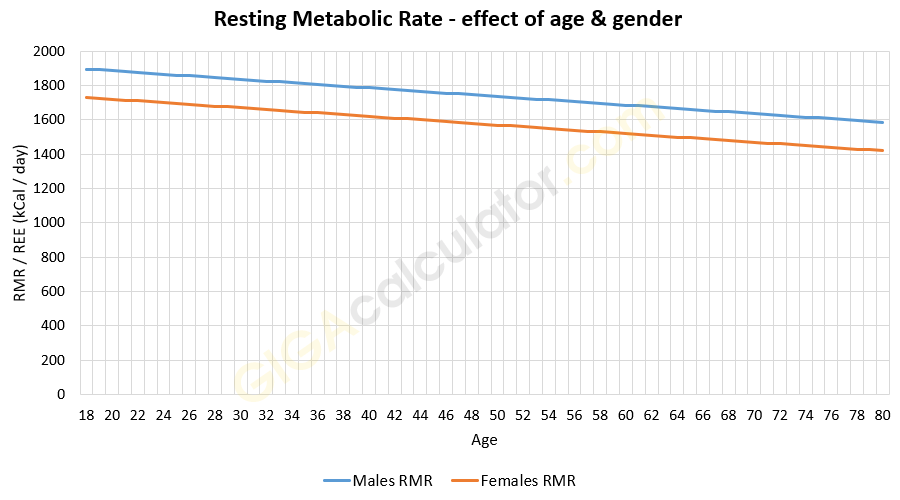
The RMR graph makes the effect of gender clearly visible with a lower average resting energy expenditure for the woman across the age range. The figure can be replicated for any dataset of interest, as long as it can be broken down by gender.
How accurate are RMR / REE estimates?
Some call into question the established formulas used to calculate resting calorie burn. For example, Owen et al. [5] state that for healthy women there is between 7% and 14% overestimation using the current formula at the time which was the older Harris-Benedict one. However, this conclusion was based on only 44 women aged 18-65 and it is unclear how representative a sample they are for the general population. For one, there were 8 trained athletes among the 44 subjects of the study (18%) which is way higher than the general population.
More recent and larger studies like Wright et al. [6] found RMR estimation to be accurate to ±10% in only around 44% of individual cases when the person was classified as overweight (BMI>25) and obese (BMI>30). However, their statistical analysis gives no indication of the direction of the bias.
A much larger study by Marra et al. [7] estimates the ±10% accuracy of estimation in around 55% of obese patients (BMI>30) aged 18-65. Importantly, Marra et al. note that using obese-specific REE formulas do not improve prediction rates compared to equations based on normal-weight subjects. According, again, to Marra et al. including body fat percentage or fat free mass percentage does not improve predictions versus those based on body weight, height, age, and gender alone.
In both of these two papers only one of the equations being examined had a fine age gradient. The rest had coarse boundaries such as 18-29, 30-59, 60+, making them much less accurate than the formula we use in this RMR calculator.
Indirect calorimetry
Indirect calorimetry (IC) should be undertaken in all cases where medical needs make it necessary to accurately measure RMR / REE calories. IC is a non-invasive procedure, generally considered the gold standard in clinical practice. However the cost and time, as well as the availability of a clinic with the necessary equipment should be considered. Our resting energy expenditure calculator remains an inexpensive and decently accurate alternative for less demanding cases where resting calorie burn needs to be calculated.
References
1Katch V.L., McArdle W.D., Katch F.I (2011). "Essentials of Exercise Physiology", fourth edition.
2Kerksick C. M. (2019). "Nutrition and Enhanced Sports Performance" (Second Edition), Chapter 38 - "Requirements of Proteins, Carbohydrates, and Fats for Athletes". Academic Press. pp.443-459
Cite this calculator & page
Cite results from this online calculator or information on this page by choosing a citation format:
Georgiev, G.Z. (n.d.). RMR Calculator. GIGAcalculator.com. Retrieved Sep 15, 2026, from https://www.gigacalculator.com/calculators/rmr-calculator.php