Return on Assets Calculator
 Add as preferred on Google
Calculate return on assets based on EBIT and the tax rate, or using net income, interest expenses, and the effective tax rate. The total book value of assets of the company or business project have to be known.
Created by  Georgi Georgiev
Last updated: Jun 10, 2026
What is return on assets
Return on Assets (ROA) is a financial ratio used to estimate how well a company or project makes use of its capital assets. It is a measure of profitability calculated as the company profit relative to the total value of its assets. As A. Damodaran puts it, it measures a company's "operating efficiency in generating profit from its assets, prior to the effects of financing" [1].
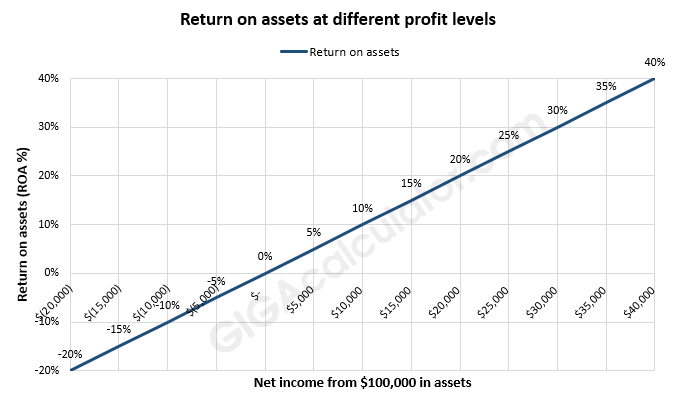
In most mature businesses with a low level of risk a 5% annual return on assets is considered pretty decent. Highly-volatile and risky investments, on the other hand, would be expected to bring in 10%, 20% or even higher return to justify the risk-adjusted cost. In the end, "good" is a subjective term that depends on the particular niche, competition, perceived risk, and investor time preference, among others.
For the above reasons ROA is a good measure for comparing companies only when they operate under relatively similar conditions, including, among others:
- same industry
- same geographical location
- same legal and regulatory framework
The more diverse these are, the more you need to consider other metrics on top of ROA.
How to calculate ROA
To calculate ROA, you need to have its financial statements and know its Earnings before interest and taxes (EBIT) and its effective tax rate, and select "Use EBIT". Alternatively, you can extract the net income, the interest expenses, and the tax rate from the balance sheet and input those by selecting "Use Net income" in our ROA calculator.
The total assets are required in both cases and represent the sum of the total liabilities and shareholder equity. Their book value can fluctuate over the period for which the return on assets is calculated. In such a scenario input average total assets instead (see arithmetic average).
The calculator output is a percentage. A positive ROA means the company is increasing its assets while a negative one means that the company is losing capital.
ROA Formula
There are two equivalent formulas that are both used in our return on assets calculator. The first one is [1]:
ROA = ( (Net Income + Interest Expenses) · (1 - Tax Rate) ) / Total Assets
Monetary input values are in the relevant currency while the result is a ratio. Net income is synonymous to profits. To get a percentage result simply multiply the asset ratio by 100.
Alternatively, if EBIT is known, the following ROA equation can be used [1]:
ROA = EBIT · (1 - Tax Rate) / Total Assets
EBIT stands for Earnings Before Interest and Taxes and is a measure of operating income (operating profits). "Total Assets" is the book value (BV) of all company assets. In both ROA formulas, "separating the financing effect from the operational effects [...] provides a cleaner measure of the true return on these assets".[1].
Example application
Using the above formula, one needs to simply substitute the relevant values and do basic math to arrive at the final value. For example, consider a business and its fiscal year 2025 balance sheet showing the following:
| Balance sheet item | Value |
|---|---|
| Net income | $100,000 |
| Interest expenses | $17,647 |
| Effective tax rate | 15% |
| Book value of assets | $500,000 |
Then its return on assets is 1/5 or 20%, since ( ($100,000 + $17,647) * (1 - 0.15) ) / $500,000 = ($117,647 * 0.85) / $500,000 = 1/5. Entering this in our fraction to percentage calculator yields 20%. This is the same as using an EBIT of $117,647 as input.
In other words, it returns 1 dollar of value for every 5 dollars of capital assets. The positive ROA of this business means it has positive operational efficiency relative to assets and positioned to increase its asset value.
References
1Damodaran, A. (2012). "Investment Valuation: Tools and Techniques for Determining the Value of Any Asset" (3rd edition). John Wiley & Sons. pp.44-45
Cite this calculator & page
Cite results from this online calculator or information on this page by choosing a citation format:
Georgiev, G.Z. (n.d.). Return on Assets Calculator. GIGAcalculator.com. Retrieved Sep 29, 2026, from https://www.gigacalculator.com/calculators/return-on-assets-calculator.php