Return on Equity Calculator
 Add as preferred on Google
Calculate ROE (return on equity) of a company based on the net income generated and the total value of the equity.
Created by  Georgi Georgiev
Last updated: Jun 10, 2026
- What is return on equity
- ROE Formula
- How to calculate return on equity
- Applications in finansial analyses
What is return on equity
Return on Equity (ROE) is a financial ratio used to estimate the financial profitability of a company from the view of equity investors [1]. It is calculated as the company net income (profit) relative to the net value of its equity. Note the difference between that equity ratio calculation and the one used to calculate Return on Capital Employed (ROCE) in which liabilities are also considered.
In a typical mature business with a low level of risk a 12-15% annual return on equity is considered pretty decent. Highly-volatile and risky investments, on the other hand, would be expected to bring in 20%, 30% or even higher return to justify the risk-adjusted cost. In this sense "good" is a subjective term that depends on the particular niche, competition, perceived risk, and investor time preference, among others.
For the above reasons ROE is a good measure for comparing companies only when they operate under relatively similar conditions, such as:
- operating in the same industry
- serving the same geographical location(s)
- operating under the same legal and regulatory framework
The more diverse these factors are, the more you need to consider other metrics on top of calculating ROE. Despite this, a common "shortcut" used in financial analysis is to compare a company's performance to the long-term average ROE of the S&P 500. The benchmark rate of 14% long-term is deemed acceptable while everything below 10% is seen as quite poor.
ROE Formula
The formula for ROE used in our return on equity calculator is adopted from Damodaran (2012) [1]:
ROE = Net Income / Book value of common equity
Net income is also called "profit". According to Damodaran, "the net income should be estimated after preferred dividends, and the book value should be that of common equity". The same advice is given in Graham & Dodd [2]
Both input values are in the relevant currency while the result is a ratio. To get a percentage result simply multiply the equity ratio by 100. Note that in case of excessive debt the equity might be a negative number, leading to negative ROE.
How to calculate return on equity
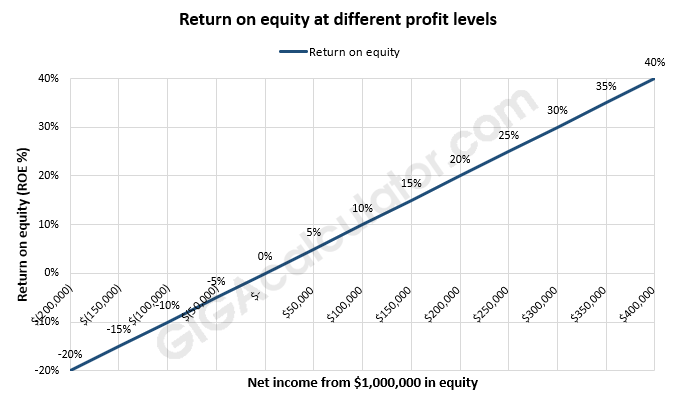
Substituting the relevant values in the above formula is easy. For example, if the net income of a company for the fiscal year is $100,000 and it had total common equity valued at $1,000,000, then its return on equity is 1/10 or 10%. You can verify this using our ROE calculator. This result means that the business returns 1 dollar of value for every 10 dollars of equity.
If a company has issued or destroyed equity during the year, it may cause the value of equity to fluctuate over the year. In such a case, you may consider inputting its arithmetic average instead.
Applications in finansial analyses
The expected or realized return on equity is used in investment valuation by business owners, stock traders, and in mergers and acquisition analyses. It is typically one of many variables that aims to establish the underlying or relative value of a company, so our ROE calculator covers just a small step in such a task.
The return on equity ratio is also used in calculating the expected growth of a company by multiplying it by the retention ratio. That ratio, known as the Income retention rate or Earnings retention rate, is simply the percentage of net income that is not distributed as dividends to shareholders. The retained income is held as reserve or reinvested by the company to fund future growth. Such calculations are known as "sustainable growth model" analyses [3].
References
1Damodaran, A. (2012). "Investment Valuation: Tools and Techniques for Determining the Value of Any Asset" (3rd edition). John Wiley & Sons. pp.46-47
2B. Graham, D. Dodd (2009). "Security Analysis" (6th edition). Graw-Hill, New York City. pp. 550-551
3Alam I., Zahid S.I. (2008). "Sustainable Growth Rate and Optimal Capital Structure". Journal of Business and Entrepreneurship. 3(2):1-12
Cite this calculator & page
Cite results from this online calculator or information on this page by choosing a citation format:
Georgiev, G.Z. (n.d.). Return on Equity Calculator. GIGAcalculator.com. Retrieved Sep 23, 2026, from https://www.gigacalculator.com/calculators/return-on-equity-calculator.php