CAGR Calculator
 Add as preferred on Google
Online CAGR calculator to calculate the Compound annual growth rate of an investment or a business metric (sales, revenue). The compound growth calculator can be used for compounding over any period: daily, weekly, monthly.
Created by  Georgi Georgiev
Last updated: May 05, 2026
- How to use our CAGR calculator
- Understanding CAGR
- Compound annual growth rate (CAGR) formula
- Compound growth calculation example
- Limitations of CAGR calculations
- Financial caution
How to use our CAGR calculator
Our CAGR calculator is an easy-to-use tool to calculate the average rate of growth of an asset. For the Initial value enter the value of the investment you made or the business revenue in the beginning of the time period of interest. In the "End value" field enter either the current value of the investment or current business revenue, or enter the final value of the asset at the end of the period of interest. Finally, enter the number of periods over which the value has grown (typically a number of years).
Once these are filled, press "Calculate" to see the present value and the compound growth rate (annual if you entered years as periods, other otherwise).
Understanding CAGR
In finance and trading, CAGR is the average compound annual growth rate of an asset's value. This is typically done for investment returns from stocks, bonds, mutual funds, or a systematic investment plan (SIP). Both investors and business owners also use it to assess the rate of growth in business metrics such as sales, revenue, clients, users, units produced or delivered, etc.. Another way to express its meaning is as the fixed rate at which a given initial investment needs to grow every year for the entire investment period to achieve a specified end value or return.
When calculated for a period different than a year it can be the quarterly, monthly, weekly, etc. rate. As such, a CAGR calculator can be useful in comparing growth rates across different data sets of a common domain. For example one can compare the revenue growth of companies in a particular industry or company divisions with the same enterprise. It can be used to make projections, including the forecasting of the future value of an investment.
CAGR is often reported in investment performance results and is based on historical returns. It is useful in comparing the annual returns of investment advisors, stocks, bonds, savings accounts, and other options. Sometimes, the investment period is truncated for easier comparison. For example, one can compare the 2-year, 5-year, and 10-year CAGR of two mutual funds or SIPs to get a better idea of the expected average rate of return with different time horizons. You can read about CAGR in more detail in our extensive article Compound Annual Growth Rate (CAGR).
Compound annual growth rate (CAGR) formula
So, how to calculate CAGR? You can do it by yourself or using an Excel spreadsheet by using the CAGR formula [1]:
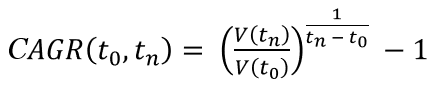
In this equation:
- V(t0) is the initial investment value
- V(tn) is the final investment value
- tn - t0 is the number of time periods over which the growth has been realized (years, months, etc.)
For example, if a business had an year-end revenue of 10,000,000 in 2018 and 25,000,000 in 2026, the compound annual growth rate is CAGR(0,8) = (25000000 / 10000000)1/8 = 12.135%.
CAGR compounds rates the same way a compound interest rate works. The same formula can be used for calculating a monthly, weekly or daily average growth rate. Of course, our growth rate calculator greatly simplifies the process.
The CAGR calculation is practically to compute the geometric mean of the growth over the number of periods of interest. This is the correct way to calculate average growth. In contrast, if one is using the arithmetic mean they would get an incorrect result (usually higher) since the average of ratios is not the arithmetic average.
Compound growth calculation example
Above is an example with a single calculation. Now let us explore what happens with different financial parameters in play. Assume a $10,000 investment was made five years ago and one wants to know what the compound annual growth rate was over those five years. The answer for several different final value scenarios is in the CAGR column of the table below.
| Initial Value | End Value | Number of Years | CAGR |
|---|---|---|---|
| $10,000 | $12,000 | 5 | 3.714% |
| $10,000 | $14,000 | 5 | 6.961% |
| $10,000 | $16,000 | 5 | 9.856% |
| $10,000 | $18,000 | 5 | 12.475% |
| $10,000 | $20,000 | 5 | 14.870% |
The compound growth of the investment on an annual basis increases parallel to the increase in the expected (or observed) final value, assuming the number of years is fixed.
Take a look at another example in which we get the same final value as the last row of the above table. Notice how the time it takes to achieve it affects the average growth rate.
| Initial Value | End Value | Number of Years | CAGR |
|---|---|---|---|
| $10,000 | $20,000 | 2 | 41.421% |
| $10,000 | $20,000 | 5 | 14.870% |
| $10,000 | $20,000 | 8 | 9.051% |
| $10,000 | $20,000 | 10 | 7.177% |
The time value of money becomes obvious as the longer it takes to make the same absolute return, the less the growth rate of the investment is. This inverse relationship reflects the time preference inherent in all economic actions.
Limitations of CAGR calculations
While the compound growth rate is useful for condensing the information about the performance of an investment fund, public company, or another business venture, it comes with limitations inherent to the way it is calculated. CAGR, being an average, is a smoothed out expectation of the performance of an investment which specifically ignores any variability in performance across years (or months, weeks, days...). To the extent that volatility is a measure of an investment's risk, it is not at all accounted for in the calculation of a compound annual growth rate.
Another major limitation is the fact that the simple CAGR formula cannot incorporate cash inflows and outflows, hence why there are no such input fields present in this CAGR calculator. The annualized profitability of such investments need to be assessed in other ways.
In short, the limitations of CAGR are:
- it cannot be computed when there are inflows or outflows during the investment period
- it specifically ignores the volatility of returns during the investment period
- it does not account for the riskiness of the investment in any way
For these reasons, comparing different investments solely based on their growth rate is not recommended and other characteristics should be taken into account to make a fully informed investment decision. E.g. a 5-year CAGR of 10% might look great compared to just 5% from another opportunity until you realize that the first one comes with a great amount of risk whereas the second one is virtually risk-free.
There are good arguments to use IRR or XIRR in place of CAGR, since most practical scenarios involve multiple cash flows which CAGR cannot incorporate. See CAGR vs IRR vs XIRR for a full discussion and comparison of these measures of the rate of return of investments.
Financial caution
This is a simple online software which is a good starting point in estimating the compound annual growth rate for any investment, but is by no means the end of such a process. You should always consult a qualified professional when making important financial decisions and long-term agreements, such as long-term bank deposits. Use the information provided by the tool critically and at your own risk.
References
1Damodaran, A. (2012). "Investment Valuation: Tools and Techniques for Determining the Value of Any Asset" (3rd edition). John Wiley & Sons. pp.272-273
Cite this calculator & page
Cite results from this online calculator or information on this page by choosing a citation format:
Georgiev, G.Z. (n.d.). CAGR Calculator. GIGAcalculator.com. Retrieved Oct 08, 2026, from https://www.gigacalculator.com/calculators/cagr-calculator.php