Potential Energy Calculator
 Add as preferred on Google
Easily calculate the gravitational potential energy (GPE) of an object of mass (m) elevated to a given height (h) above the ground. The GPE calculator can also be used to solve for mass or height.
Created by  Georgi Georgiev
Last updated: Aug 23, 2026
Using the potential energy calculator
This gravitational potential energy calculator is useful for estimating the energy an object possesses by being elevated a certain height above the reference point, often the ground. By knowing its mass and the gravitational acceleration, its gravitational potential energy can be calculated. The tool can be used to find the potential energy of a ball, a person, a body of water, and pretty much any object you can think of.
To calculate the potential energy you need to know the body's mass and relative height, assuming standard gravity on Earth of 9.80665 m/s2. The GPE calculator can also be used to solve for any of the other values: mass and height. The respective input fields will be hidden or displayed upon selecting what you want to use the calculator for. When solving for mass you need to know height and potential energy, while when solving for height you need to know the object's mass and energy.
The output of the tool is in Joules (J, kJ, MJ), Watt-hours (Wh, kWh), calories (Cal, kCal) and foot-pounds (ft-lbf). When the output of the tool is mass or height it is in both standard metric units and imperial units with the unit automatically selected depending on how big or small the resulting value is.
If you are interested in elastic potential energy, check out our elastic potential energy calculator and consider our kinetic energy calculator for computing the energy of a body in motion.
Formula for potential energy
In physics, the formula for gravitational potential energy (PE or sometimes PEg) expressed in terms of the object's mass (m) and its height relative to a chosen reference level (h) (often the ground) is the equation:
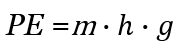
g is the gravitational acceleration in m/s2. The default value of 9.80665 works for most typical problems. A more precise value may be needed if exceptional precision is required since for a typical Earth calculation actual g varies between 9.78 and 9.83 m/s2. An entirely different formula is needed for scenarios with very large altitude changes (to account for the changes in g).
This equation is the core of this online potential energy calculator and it shows the relationship between mass and energy depends on height and the gravitational acceleration. Specifically, an object has higher potential energy if it is on a higher place, and vice versa. The formula also shows that an object with a larger mass has a higher potential energy, all else being equal.
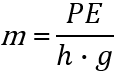
Calculate mass given PE and height
Solving for mass is a matter of reordering of the formula:
Calculate height given PE and mass
Alternatively, solve for height by using the equation:
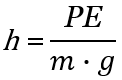
in which "PE" is potential energy and m is mass.
Calculation examples
Potential energy is used in a variety of fields. Gravitational potential energy plays a role in structural engineering and the design of various buildings. Lifts and elevators which rely on a counterweight being moved up and down also depend on such calculations. Hydroelectric storage is another prominent example.
Example 1: A skier has a mass of 80 kg and is standing on top of a steep slide with a top-to-base vertical height of 150 meters. What is the skier's potential energy? Using the first potential energy equation above, replace the values for m, h, and g to get PE = 80 · 150 · 9.80665 = 117,679.80 Joules or 117.68 kiloJoules.
Example 2: A ball with a mass of 500 grams is sitting on a rooftop 20 meters above ground. Find the potential energy of the ball. First we convert 500 grams to 0.5 kg and then replace in the formula: PE = 0.5 · 20 · 9.80665 = 98.07 J. This is equivalent to 72.33 ft-lbf.
Example 3: Water stored in a dam needs to store 10,000 MJ (MegaJoules) of potential energy. What should the water mass be if it will be falling for 500 m before hitting the propellers of the electricity-generating turbines? To answer, first convert MJ to J: 10,000 · 1,000,000 = 10,000,000,000 J. Proceed to replace the values in the mass via gravity and height formula to get m = 10,000,000,000 / (500 · 9.80665) = 2,039,432 kg. The dam needs to have at least 2,040 metric tons of water in it to store the specified amount of energy.
Please note that this is an example which works only with the somewhat unrealistic assumptions that all water is at the same height and that there is no energy loss during its way down. Also, by using our calculator you would not need to perform these unit conversions, as they are handled for you on the fly.
Ton vs tonne, tons vs tonnes
When solving for the object's mass both tonne (metric ton) and ton (short ton) are present in the output. The tonne is used by all countries in the world and is defined to be equal to 1000 kg by the international body of standardization. The ton is currently only used in the United States and is equal to 2000 pounds (2000 lb).
References
1NIST Special Publication 330 (2008) - "The International System of Units (SI)", edited by Barry N.Taylor and Ambler Thompson, p. 52
2"The International System of Units" (SI) (2006, 8th ed.). Bureau international des poids et mesures. pp. 142–143. ISBN 92-822-2213-6
Cite this calculator & page
Cite results from this online calculator or information on this page by choosing a citation format:
Georgiev, G.Z. (n.d.). Potential Energy Calculator. GIGAcalculator.com. Retrieved Oct 12, 2026, from https://www.gigacalculator.com/calculators/potential-energy-calculator.php