Time Dilation Calculator
 Add as preferred on Google
Calculate time relative to a traveling observer with this relativistic time dilation calculator. It works under special-relativity and assumes constant relative speed.
Created by  Georgi Georgiev
Last updated: Aug 21, 2026
What is time dilation
In physics, relativistic time dilation denotes the observed time interval between two events as experienced by an observer considered stationary relative to an observer moving with certain velocity. Calculations of time dilation based on relative velocity are based on Einstein's theory of special relativity [1] and typically focus on speeds approaching the speed of light.
Proper time (Δτ) is the time measured by the traveling observer's clock: a clock that passes through both the initial and final event. In a frame where that clock is moving, the corresponding coordinate-time interval is longer meaning that from the point of view of a stationary observer the moving clock would accumulate less proper time between corresponding events than his stationary clock. Such an observer would see a clock that is moving relative to them tick more slowly than an identical clock at rest in their own frame of reference.
The relationship between the two elapsed-time intervals is calculated by the Lorentz factor (a.k.a. relativistic factor): a dimensionless quantity that relates measurements between inertial reference frames. In this case it is the relative time dilation for a stationary observer, or how much slower the moving clock would appear to tick from his perspective. The relationship was derived by Einstein from the two foundational postulates of special relativity, namely the principle of relativity and the constancy of the speed of light in all inertial frames.
Time dilation formula
The formula for time dilation computes a relative time interval Δt (Delta-t) based on the velocity of a travelling observer (v) and a time interval from the perspective of that observer's proper time Δτ (Delta-tau). The equation to calculate the time interval for the stationary observer's inertial reference frame (Δt) is derived from Lorentz transformations as such [2]:
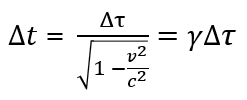
In it, c is the speed of light in vacuum which is exactly 299,792,458 m/s [3]. γ (gamma) is the Lorentz factor. The formula shows that the closer a travelling observer's speed is to the speed of light, the more it affects relative time.
This equation is used in this time dilation calculator. Importantly, the formula only considers special relativity and does not account for gravitational time dilation from general relativity.
Time dilation curve
The dramatic increase in relative time as an object approaches c can be shown by plotting relative time for the same observer time interval, but at different speeds. With a time interval of one which can represent 1 second, 1 hour, 1 day, 1 year, etc., this is exactly the Lorentz factor as well.
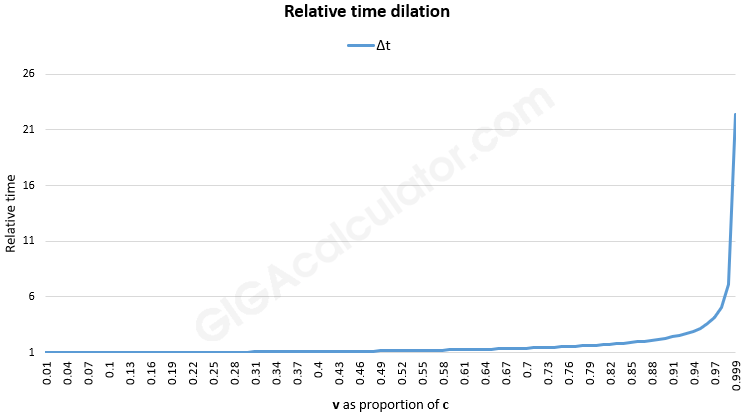
When the velocity of the traveling observer is less than a quarter of the speed of light, it results in a barely noticeable time dilation of less than 3.5%. As it approaches c however, it begins to increase rapidly and the closer it is to c the Lorentz factor tends to infinity. As an approximate threshold, time dilation may become important when an object approaches speeds on the order of 30,000 km/s (1/10 the speed of light) at which point the dilation is about 0.5%.
How to use the calculator
The input is straightforward: enter the relative speed of the traveling object (e.g. clock) or traveling observer, relative to the observer at rest in the chosen inertial frame. For example, if we consider us on Earth to be the stationary observer and we want to compute the time dilation relative to someone travelling in outer space with a constant relative velocity of 1/2 the speed of light, enter 0.5 and choose "c" as the measurement unit, or equivalently enter 149896229 and choose meters per second (m/s).
Then select how long of a time interval the traveling object has experienced, for example 10 years. After pressing "Calculate" the result will include the relative time elapsed and the time dilation percentage. In the above example, while an astronaut's clock measures 10 years have elapsed while traveling with a speed of ½c, we would experience just over eleven and a half years on Earth, or 15.47% longer time interval than the astronaut.
References
1Einstein A. (1905). "On the electrodynamics of moving bodies". Annalen der Physik. 17:891-921, DOI: 10.1002/andp.200590006
2Vesselin P. (2009). "Relativity and the Nature of Spacetime" (2nd, illustrated ed.). Springer Science & Business Media. p.87. ISBN 978-3-642-01962-3
3NIST (2024). "2022 CODATA recommended values: speed of light in vacuum". The NIST Reference on Constants, Units, and Uncertainty. Retrieved Aug 21, 2026.
Cite this calculator & page
Cite results from this online calculator or information on this page by choosing a citation format:
Georgiev, G.Z. (n.d.). Time Dilation Calculator. GIGAcalculator.com. Retrieved Oct 12, 2026, from https://www.gigacalculator.com/calculators/time-dilation-calculator.php