Ratio Calculator
 Add as preferred on Google
Use this ratio calculator to easily solve ratio equations. Enter the first ratio and one number from the second, in order to compute the other. Easy aspect ratio calculation.
Created by  Georgi Georgiev
Last updated: Jun 20, 2026
- What is a ratio
- How to solve ratios
- Multiplication, division, and reduction
- Odds as ratios
- Aspect ratio calculation
- Applications in geometry
What is a ratio
A ratio is a mathematical relationship between two numbers that expresses how many times the first number contains the second. More specifically, it is a proportional relationship. For example, the ratio between cars on the street and people in them would be 1:5 (1 to 5) if each car can fit 5 people and all cars are loaded to the maximum. If there are just 2 persons in each car, the proportion would be 1:2. A ratio can also be between things in a container, area, or subgroups in larger groups. For example, if you have 10 fruits and 3 of them are apples and 7 are oranges, the ratio between apples and oranges is 3:7. The proportional relationship of apples to all fruits will be 3:10, which is often written as a fraction: 3/10 in this example.
The numbers in a ratio can be integers (whole numbers), decimal numbers, or fractions. When the two quantities are measured in the same unit, the output from our ratio calculator is a dimensionless number. If the units are different, then it is called a rate, e.g. in productivity calculations, if it takes 1 person 11 days to complete a given project, the daily productivity rate is 1:11 (he or she can complete 1/11-th of the work in a day), while the monthly productivity, assuming 22 working days a month, is 2:1 (he or she can complete 2 projects in 1 month).
Ratios calculations are often used for business metrics, in accounting, and investment decision-making to calculate metrics like profit margin, markup, ROI, return on assets, and conversion rate among many others.
Complex ratios
There are more complex proportional relations which require more than two values in a single notation. For example, if one has 3 apples, 5 oranges and 2 bananas, the ratio between them is 3:5:2. These are useful when describing the relationship of dimensions in three-dimensional space, among other things.
How to solve ratios
Ratio equations usually involve two proportions on both sides of an equation, with three numbers from the ratios given and the fourth being solved for. Solving ratio equations is all about finding which number, multiplied by the one number given on the side of the missing number, would result in the same relationship as the one on the other side of the equation.
You can use simple equation rules: multiplying or dividing both sides of the equation in order to leave the missing variable alone on one side of the equation. For example, solving x:2 = 8:4 for x would be equivalent to solving x / 2 = 8 / 4, requiring us to multiply both sides by 2, to get to x = 8/4 x 2 = 2 x 2 = 4.
In our ratio solver, just leave the part of the ratio you are solving for empty, then press "Calculate" to get what number needs to be there to balance the equation.
Multiplication, division, and reduction
If you multiply each member of a ratio by the same number, the proportionality remains the same. For example, the ratio 1:3, when multiplied by 4, becomes 4:12, and in it the proportions between the quantities remain the same. Using the same logic, if you divide each quantity in a ratio by the same number, the number remains the same. These are examples of ratio scaling.
Reducing a ratio is done the same way as simplifying fractions. It requires finding the smallest integer that preserves the relationship, which is the greatest common divisor, also known as a common factor. As an example, take 4:12. The GCD of 4 and 12 is 4. Divide the value on each side by 4 to get 1:4, which is the most convenient form of the ratio to use. It can be written as the fraction 1/4.
Odds as ratios
Odds, or probabilities of events occurring or not occurring, are expressed as ratios. Ratios usually add up to 1 or 100%, for example 0.3:0.7 or 30:70, but most often they are presented in a form convenient for apprehension. In this case that would be 3:7 (30/10 and 70/10, and 0.3 x 10 , 0.7 x 10). Such odds are often used in gambling and other games of chance, for example the chance for you to win the US Powerball lottery jackpot (2018 rules) are 1 in 292,201,338, or 1:292,201,338, as can be seen on our lottery number generator page. Ratios of this kind are also how odds in sports betting are presented.
Aspect ratio calculation
Ratios are also often used when one needs to calculate the aspect ratio of an image or video, for scaling maps or models, as well as in sizing cooking recipes. For example, some old TV sets had an aspect ratio of 4:6 (width by height), while others had 2.35:1. New LCD, OLED, and other TVs and screens usually have a ratio of 16:9, which is in fact a compromise between the two.
Models of cars and buildings are often made in ratios of 1:20 to 1:40, while for maps the scaling is often much higher, for example 1:1,000,000 which means that 1 cm on the map would be 1,000,000 cm in real life (10 kilometers).
Applications in geometry
Other than maps, ratios are very common in geometry. One of the most famous ratios in the world is denoted by the Greek letter π (pi) and expresses the relationship between the diameter of a circle and its circumference. It even has its own day of celebration: March 14 (3.14.YYYY)! It is used in the calculation of the area and circumference of circles and ovals, as well as the volume of spheres and spherical bodies. Similarly, trigonometric functions are also ratios: the sine, cosine and tangent function are simply expressions of the proportional relationship between two sides of a triangle, relative to a specified angle.
Plotting ratios on charts
Ratios can be visually represented using lengths or areas, and rarely - as volumes. An example is below:
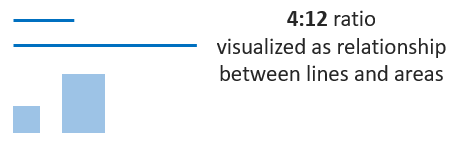
When visualizing, it is best to use thin lines or bars, as these are the least misleading. Wide bars may trigger subconscious comparison between their areas instead. This would be misleading to the extent to which the visual relationship of areas does not correspond to the visual ratio of lengths.
Cite this calculator & page
Cite results from this online calculator or information on this page by choosing a citation format:
Georgiev, G.Z. (n.d.). Ratio Calculator. GIGAcalculator.com. Retrieved Sep 26, 2026, from https://www.gigacalculator.com/calculators/ratio-calculator.php